
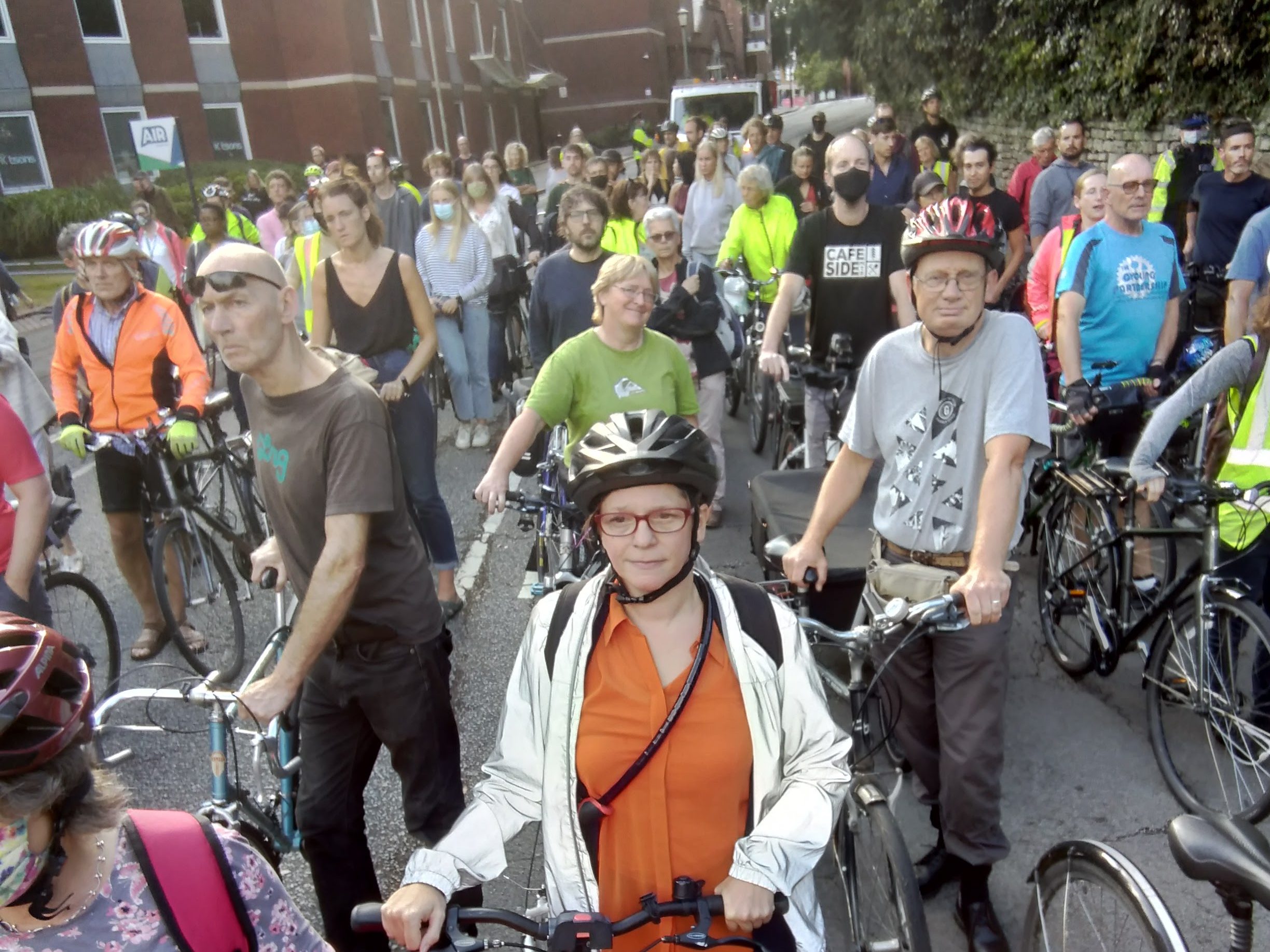
I spent yesterday evening lying on my back in the middle of a B road, my legs steepled awkwardly to avoid the woman lying in the road behind me, squinting as I stared straight into the bright sky and wishing I’d thought to put my sunglasses on before I lay down. It was too late to put them on now of course, corpses don’t move and I was trying to do my best impression of a corpse as part of the Exeter Cycling Campaign’s Die In and Vigil to mark the recent tragic death of Maria Perez-Gonzalez, and to call for action about the number of cyclists killed on the UK’s roads more broadly.
It’s always difficult for these things to manage to be both a memorial for grieving friends and family, and an angry protest over an underlying issue, and I feel that this event managed to do both very respectfully. Although I, and I suspect the majority of people there, had never met Maria, I came away with the impression of a caring, compassionate person and a heartbreaking loss, a nurse with two sons who made people smile on long shifts, had beautiful houseplants and always smelled of coconut oil.
And I do feel that to be a cyclist in Exeter and in the UK more broadly you do have to be a caring and compassionate person, worried about your environmental footprint and willing to take risks with your own safety, and it absolutely should not be that way. It’s easy to dismiss this sort of thing as a one off, a drunk driver, but roads should be designed so that cyclists aren’t in the way of drunk drivers in the first place.
Part of the reason that this feels so close to home is that I had a near miss myself on this same road a few weeks previously, about 200 metres from where Maria was killed. As I was rounding a junction which takes a fair bit of concentration, a guy passing in his van leaned out of his open window and screamed in my ear, which startled me so much I almost fell off my bike. I don’t know if it was a stupid thoughtless prank or he actually hated cyclists so much he wanted me to have an accident, but the fact I do genuinely consider the latter option a possibility is incredibly depressing. More depressing still was that when I shared this story online and at work I heard countless others in return, of insults and even physical objects thrown at cyclists from passing cars and even one from a woman who fell off her bike when a passing driver slapped her bottom. I have to confess that I was quite shaken by the incident – while I felt confident cycling with incidental traffic dangers deliberate malice is something else and I started to question whether I should be cycling at all if I couldn’t trust myself not to lose control of my bike if I was startled. Cycling to the vigil was the first time I’ve had the nerve to get on a bike since.
I know drivers find cyclists annoying because they slow them down, and I know pedestrians dislike them because some cycle on pavements, but the problem is the lack of proper cycling infrastructure in this country keeping bikes away from cars on the roads particularly at pinch points, which would also mean cyclists would feel safer and some wouldn’t feel the need to cycle on pavements. Our cities don’t have to be set up for conflict. If we did have proper safe cycling infrastructure maybe we wouldn’t divide ourselves up into these tribes, driver vs cyclist, too, we’d just use either transport option, whichever suited the journey, and probably have a lot more empathy for one another. If it was just an inconsiderate joke I bet the van driver wouldn’t have done that if he’d ever cycled and knew that these junctions need concentration.
It shouldn’t take either recklessness and lack of concern for personal safety (which I suspect was what allowed me to cycling in London as a student) or a degree of environmental concern strong enough to outweigh the perception of risk to get people cycling, it should be a safe option for everyone. Cycling should surely be seen as the more social option not considered the antisocial one – by using a bike instead of car I’m making it easier for drivers to find parking, not contributing to congestion or local air pollution or global fossil fuel emissions and by not choosing public transport right now I’m one fewer potentially infectious person breathing in an enclosed space. Cycling benefits everyone, and yet our cities are not designed for it, driving is considered the default. And this is not by any means inevitable, it’s a result of decisions made when designing our cities, with car travel considered the default. As a thought experiment can you imagine anyone trying to build houses or a new retail or leisure facility without car parking spaces? Why is the default assumption that cars must be catered for?
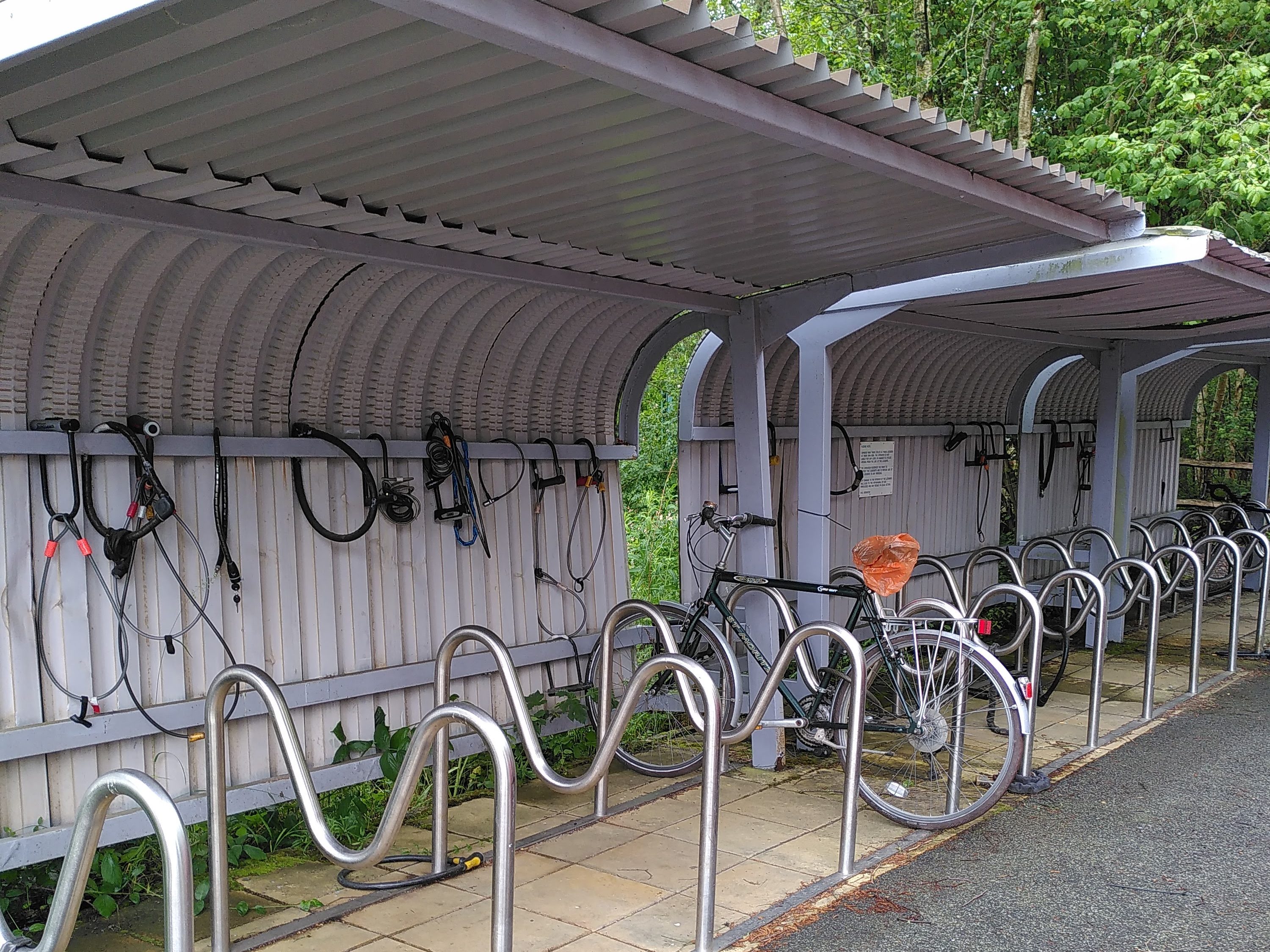
There is some movement in the right direction – recent changes in the highway code have established a hierarchy of road users, with the most vulnerable pedestrians and cyclists at the top. And after dramatic rises in cycling over lockdown a number of cities have introduced new cycle lanes, although many of these now need defending after objections from a small but noisy anti-cycling minority. There are also some isolated examples of good design with cycling considered at the outset rather than as an optional add-on, like the station forecourt below, although this is still so unusual I feel the urge to photograph it when see it!
The last year has shown us that what we previously thought were immutable aspects of the operation of our society can be changed, and the UK doesn’t have to be this way, with cars the favoured mode of transport. The Netherlands nowadays is an oasis of cycle provision, but it hasn’t always been this way; in the 1950s they were on the same fast road to car culture that we were, but outrage over child road deaths led to a change of direction to a country where it’s now not unusual for children to cycle to school on their own, something unimaginable on the UK’s roads. We could do the same. And as the recent IPCC report makes clear, we’re going to have to do something about our infatuation with individual petrol-burning cars if we want to maintain a liveable planet, so we’re probably going to have to. Choosing the more sustainable mode of transport shouldn’t have to involve risking your personal safety, and we can redesign our cities so it doesn’t have to. We don’t just have to accept that good people will die for making the better transport decision.


Interesting stuff Jules thanks.
I tend to drive pretty well anywhere now but spent the 1st 30 years of my life cycling everywhere instead.
There’s little doubt in my mind that the roads have become FAR more dangerous for cyclists over the last 40 years…. so much so in fact that whilst I was cycling confidently and safely on my home town’s roads at Ben’s age, these days I’m honestly not sure whether i am happy about him doing similarly now.
I have been knocked off my bike twice. Once really quite nastily by a transit van who turned left at speed, without indicating… straight into me.
The worst thing about that incident though was the fact the motorists held up behind me on the road just looked away when I peeled myself off the road.
So I picked up by bent and bucklwd racer bike, put it on my shoulder and just walked up the middle of the road for the next 5 minutes (I was on my way to work and work was 5 minutes walk away) ahead of them as an “EFF YOU ALL” protest. How to win friends eh?!
On a linked point… what do you think about the common behaviour these days of councils turning pavements into cycle lanes (and I’m not talking about split lanes, one marked with a pedestrian and one marked with a cycle… I’m talking about the entire pavement given over the pedestrians and cycles in a newly designated, singular cycle lane.
This, I have no hesitation in saying, did my HEAD IN during the worst of the lockdowns when all we could do (at times) was walk on pavements for exercise.
It still rankles with me to be honest.
LikeLiked by 1 person
Yeah it’s odd seeing the new generation learn to cycle isn’t it. It’s been such fun watching Elsie and Bea learning and growing in confidence, but I do find myself wandering whether they’ll be able to use that skill for anything other than leisure trips as they grow up. Tom and I used to cycle a lot as kids in Belgium, then when we moved to the UK my Mum took one look at the roads and decided we weren’t cycling here and I didn’t cycle again till I got to university. I was really pissed off at the time, but honestly now as an adult I’m not sure I can blame her.
I’m all in favour of shared spaces the way they’ve done them in parts of London, closing whole roads to cars and just making them mixed pedestrian and bike, but you’re right they don’t really work on narrow pavements – pedestrians just slow cyclists down and cyclists clip pedestrians. Honestly I think they’re a cop-out on the part of councils, instead of taking any space away from cars they just take it away from another form of active transport.
LikeLike