

I’ve now had a little time to process the results of December’s elections, and move on a little beyond the shock, grief and very real fear (two of my disabled friends have explicitly stated that they don’t believe they will survive another five years of austerity driven cuts) that were my immediate reactions.
I shared my friends’ posts explaining how inadequate the support they received now was and how punitive the process they had to endure to qualify it was, of course I did, along with other desperate pleas from friends in the NHS and other public services about how overstretched and under-resourced they were, but of course no one outside my little social bubble listened. I can only conclude that those who don’t personally know someone struggling don’t believe it’s really happening (and in an era when social media has become our primary means of communication and is so easily and frequently manipulated why would they believe it) or don’t want to believe that the victims didn’t bring it on themselves; I’ve written before about how victim blaming is a reassuring way of convincing yourself that bad things could never happen to you. If you can convince yourself that people only fall into poverty because they’re lazy or stupid or can’t budget, or that the only thing stopping disabled people from finding work is a negative attitude, and can further convince yourself that you wouldn’t make these mistakes, you can convince yourself you will always be safe. The truth of course is that the proportion of us who are safe is steadily diminishing year on year, and it only takes an accident or disease or redundancy or relationship breakdown to fall from the lofty heights of comfort and security. And we seem to have collectively decided as a society to start slashing great holes in the social safety nets that are supposed to arrest the downward plummet, on the grounds that the people who fall weren’t up to scratch and so weren’t worth saving anyway.
And I can’t accept that.
Looking around and seeing a country and increasingly a world that is organised in a way that is so antithetical to anything I would consider acceptable, would consider compassionate, and believing that this is the world that a majority of people apparently voted for would drive me to despair if it weren’t for one thing. That one thing is that I know I’m not alone, that there are others out there who want a better world too. Before the election I watched my friends register people to vote at food banks and distribute leaflets and knock on doors and drive people to polling stations. That energy and courage and determination cannot be allowed to have been for nothing, and it hasn’t been. One month later I’m already seeing it transmute, seeing people organising to design free apps for foodbanks and raising money for refuges and homelessness charities, building networks and connections and working out ways to sustain one another for the long haul. And of course I see the my friends who are carrying on doing what they were doing before the elections, caring for patients and teaching children and baking birthday cakes for kids who can’t afford them and supporting women in recovery and refugees, and they give me hope.
We’ll do this because we have to. It’s the time of year for resolutions, and my resolution is to look around my network, around my community, and make a promise that every. single. one. of these people will still be here in 2024. We are not going to lose one more person to austerity. And I can’t take shoulder responsibility, that’s an impossible ask for one person, but I don’t have to because we’re all going share the load. We’re all going to support one another and together we’ll make it through long enough to change the system from something we have to fight against to something that works to sustain us.
So how do we do it?
Get involved with local politics
While funding levels for local services are set at a national level, many of the decisions on prioritising resources for things like bus services, social care, greenspaces, and waste and recycling are set at a local level. You can find details of your local councils by entering your postcode here. Elections at the local level happen on a different cycle to national elections, and some levels return multiple members per ward instead of a single candidate, so there are likely to be several opportunities to elect local candidates who better align with your political preferences sooner than 2024. Turnout in the 2017 local elections was only 35%, so there’s certainly scope to get a greater share of the vote out for progressive candidates there.
You can contact your local representatives about issues of concern to you directly (their contact details can be found through the council or authority websites found here) and at some levels of local government there is scope for members of the public to attend decision making sessions in person. And there is scope to campaign on local issues outside of local politics too. Try to read the local newpapers to find out about campaigns to save local libraries, A&E departments and community centres (if any of the latter still exist where you are) and join them.
Hold our national government to account
The coming months are likely to be a time of considerable change in the opposition parties, and I’m already seeing think pieces about how we on the left lost because we weren’t willing to fight dirty and campaign on lies the like the Tories did, or didn’t pander to xenophobia and racism. There’s going to be a lot of temptation to drift to the right and we absolutely need to resist this: in the end if we win by adopting their ideas, their ideas will still have one, it doesn’t matter who implements them.
“If we desire a society without discrimination, then we must not discriminate against anyone in the process of building this society.” – Bayard Rustin
It is in the end the party members who will determine the direction opposition parties take, so if you want to have a chance to influence the choice of leader or of policies I would recommend joining a political party.
You can join the Labour Party here. The deadline to join to be allowed to vote in the leadership elections is the 20th of January.
Whatever their political affiliation, MPs do at least have to keep a record of the issues their constituents contact them about between elections. You can find your MP’s contact details here, as well as information on their voting record. Make them aware that hounding immigrants and the disabled and selling off our public services is not as universally popular as they may believe it to be. Jack Monroe makes the excellent suggestion to check the Register of MPs’ Financial Interests to find out whether they own shares in private healthcare firms. If they are likely to profit from an NHS selloff why not contact them about this and publicise it as widely as possible.
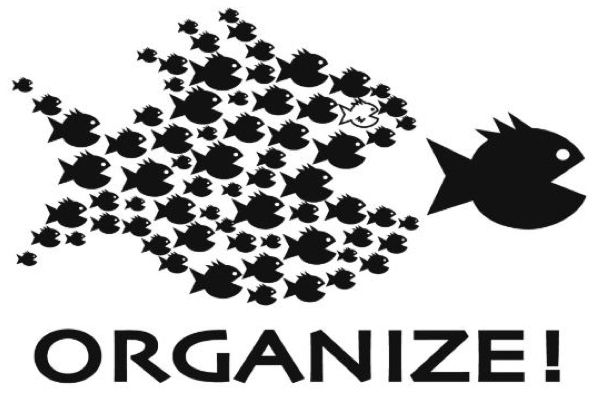
Attempts to change government decisions are more likely to be effective if they’re part of an organised campaign. Apart from the rediscovery of sausage rolls by vegans, pretty much the only bright point of 2019 was the proliferation of organised campaigning groups working on everything from climate change to Brexit to funeral poverty, so I would recommend working out which issues are of greatest concern to you and where you feel you can offer greatest expertise and joining forces with groups campaigning in those areas.
Support the charities trying to pick up the pieces
To be clear it is in no way a good situation where charities, organisations dependent on the whims and attention spans of individuals rather than capable of any sort of systematic provision, are left to pick up the pieces when the sixth richest country can’t get its act together to provide the basics of a decent life to a sizable chunk of its citizens. But this is where we are right now, that even if sticking plasters can’t stop the bleeding enough of them can hopefully slow it enough to keep the patient alive until we can solve the problem.
If you have money of course donate, but if you don’t you can still help by sharing appeals, organising fundraisers, giving time or donating spare goods to foodbanks. The following organisations operate at a national level, but there are any number of grassroots organisations operating at a more local level too that I would urge everyone to seek out and support if you can.
The Trussell Trust is the major provider of foodbanks UK wide, with dropoff points for non-perishable food in many major supermarkets. Remember that as well as food items, toiletries, sanitary towels and tampons and can openers are also desperately needed. As well as food items, financial donations are also vital as they make it easier to plan and purchase what is needed rather than having to rely on the selection donated.
Crisis and Shelter are national homelessness charities, and Shelter has recently launched a bank account for homeless people so that those without an address aren’t locked out of receiving benefits.
Refuge supports women and children fleeing domestic violence.
The Refugee Council and Right to Remain support and campaign for refugees and asylum seekers.
Disability Rights UK, Sisters of Frida , Heart and Soul and Breakthrough UK are advocacy organisations run for and by disabled people fighting for the idea that disabled people are just as entitled to a full and dignified life as abled people. Thanks to Robin of Axes’n’Yarn and Emma of Ladylike Punk for directing me to these.
Join a union
With workers’ rights under threat, and EU-mandated rights likely to be eroded further after Brexit, it’s more important than ever to join a Trade Union if you can. (I’m grateful to Robin of Axes’n’Yarn for informing me that unemployed people can also join Unite and Unison for a reduced fee). Boris Johnson has already promised to make industrial action illegal for public transport workers, so we need to fight not just for our employment rights, but for our continued right to organise collectively to improve our working conditions.
If you rent you can also join a renter’s union, which support tenants challenging rogue landlords and retaliatory evictions. Acorn has branches throughout the country whereas the London Renters’ Union is (unsurprisingly) based in London. Generation Rent is a national group campaigning to improve tenant rights.
Take care of ourselves
“Self care” has been very successfully appropriated by corporations trying to convince us that we need to buy their fancy hot chocolate or scented candles or string lights to do it, but the core concept once your strip those messages away remains vitally important. In a society that tells so many of us that we are valueless if we don’t look a certain way or belong to a certain group or earn a certain sum or meet a certain standard, treating ourselves as though we were worth caring for is a surprisingly radical act.
This zine (pdf) is well worth a read to challenge the idea that self care is selfish or self indulgent; certainly I’ve found in my life that it’s only when I take proper care of myself that I have the mental resources to take care of others and to work towards making life better for everyone.
Keeping yourself healthy both physically and mentally will not of course solve the problems both you and the world have to deal with, but will mean you have slightly more resources with which to deal with them. Poverty, xenophobia, illness and climate change continue to exist if you eat vegetables, take your medication, go for a walk and switch your phone off from time to time, but I certainly find myself rather better able to keep going in the face of them if I do these things.
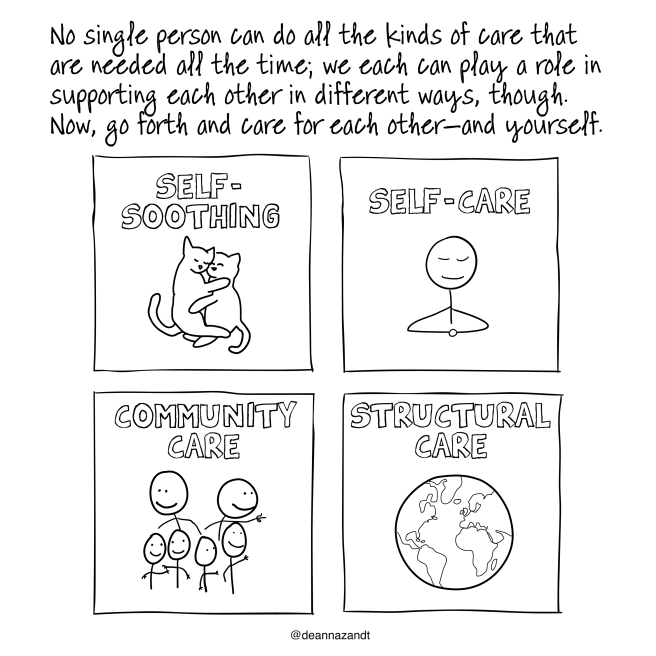
It is of course easier to practice self care for some people than others; it’s going to be hard to eat healthily if you’re reliant on foodbank packages that contain no fresh food, to get out and exercise if you have no accessible, safe outdoor space to walk or run in, to get enough sleep if you can’t get affordable therapy for your untreated anxiety disorder. I do still think it’s valuable though to remind yourself that whatever your circumstances you’re just entitled as everyone else to do everything in your power to make your life easier, more enjoyable or more fulfilling. That’s why if we have capacity, we need to practice the next levels of care up from self care: community care, supporting one another within a system that is not designed to care for us, and structural care, changing that system. I would really encourage everyone to read this comic by Deanna Zandt, which provides the best explanation I’ve read of this idea.
Take care of each other
We feel instinctively that kindness feels good, but it goes deeper than that. We are in the end social primates who evolved to live in interdependent, and an increasing body of research is showing that not only do supportive relationships and compassionate interactions increase wellbeing but that their absence can have measurable negative impacts on our health.
It can be hard to ask for help, we can be scared to burden others or feel ashamed of letting the side down. Jack Monroe has written movingly of living in a freezing house without lightbulbs, too scared to answer the door in case it was bailiffs, and how isolated they felt that no one around them knew what they were going through.
But there are people out there who want to help if they can. It may sound bizarre but one of the most helpful things anyone did for me, when I was despairing after the election results and terrified for my friends, was to post on Facebook that she couldn’t face leaving the house and had no money for takeaway, asking if anyone could Paypal her money for a pizza. And in that moment I couldn’t do anything for the country as a whole or my friend in hospital, but I could buy someone who had had an absolutely shit year a damn pizza and make things a tiny bit easier for her in the short term, and suddenly I felt a tiny bit less useless.
So please keep each other for help – maybe people won’t be in a position to help you, but maybe they will, and maybe that helps everyone.
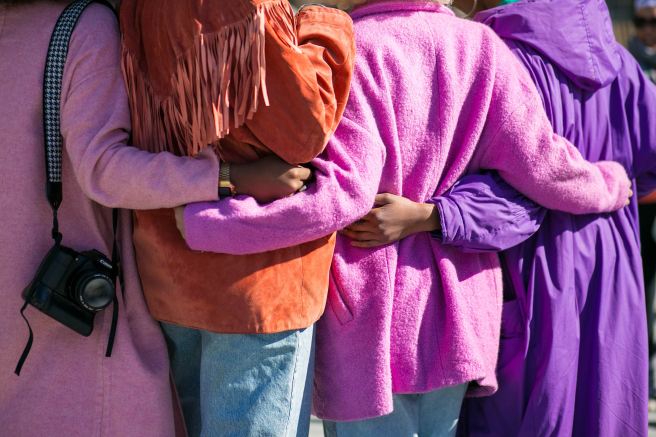
Set boundaries and work within our capacities
My role in all this is not social activism. I’m an introvert, I find interacting with most people tiring at the best of times. I find interacting with strangers, whose behaviour I have not yet learned to predict and whose expectations from me I haven’t yet determined, exhausting. And I find engaging with human suffering devastating and am completely incapable of setting boundaries in the face of desperate need. I have tremendous admiration for my friends who work with the homeless and victims of torture and volunteer in refugee camps, and I know that if I ever tried to do that I would burn out in two days and be rendered unable to help not only those I was supposed to be serving, but also everyone else in my life and myself. And I wish I hadn’t had to learn that the hard way.
What I am good at is working with data and computers and plants and animals, and for this reason I feel that my main part in this shared project of bringing about a better world is environmental advocacy and restoration. Unlike working with people, working with the natural world not only doesn’t deplete my energy but actually brings me joy ,even amid the knowledge of the damage we are doing to our beautiful planet. I know there are those who see prioritising work for non-human nature when there are so many humans struggling is self-indulgent or even misanthropic, but I have finally learned that I can only work usefully within my own capacity to do so, even though the greater need may lie elsewhere.
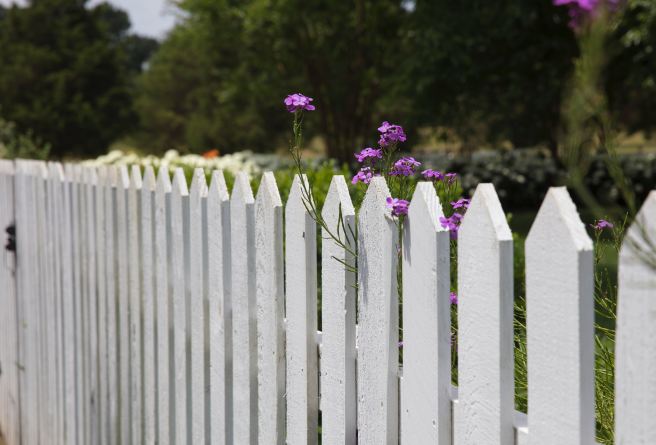
Learning this, and learning to set boundaries and refuse to help when I knew I couldn’t do so and still protect myself, has been a painful process and I know there are people I care about who feel let down that I haven’t been able to give them the support they needed from me. But learning this about myself has been the difference between the ability to contribute what I can, and being able to contribute nothing at all. I’m sharing it in the hope that others will learn this a bit faster than I did, and that we stop shaming each other for not working in the area we consider most urgent but instead learn to accept that we all bring different skills and capacities, and can only work within our own limits.
It may be that your role is to organise and build movements, to feed the hungry or support the destitute or lobby parliament. But your role may also be to sign petitions or share GoFundmes or listen to your friends when they struggle or fix people’s phones or bake cakes or write fanfiction that people can read to recharge, and that is all important too.
Expand our sphere of influence
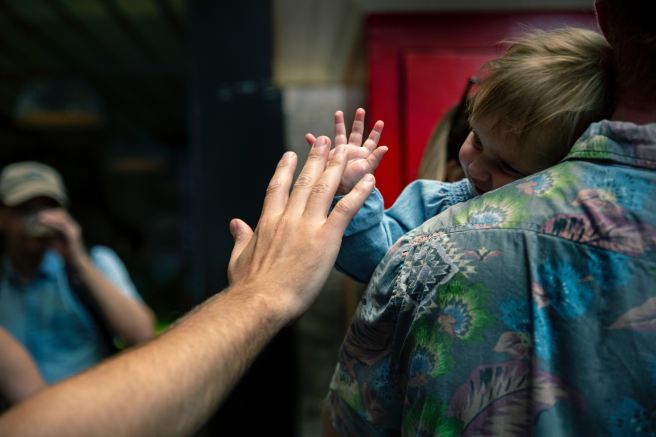
As I’ve got older I’ve come to realise that I’ve never changed anyone’s opinion by debating over the internet; the only people who have been willing to listen to me on issues I disagreed with them on have been those who knew me in real life and respected me in some other context, as a knowledgeable person or responsible colleague at work for example. I feel that strangely, the area of my life in which I’ve made most progress in sharing ecological ideas and actions has not been within my own friendship group or activist circles, which tend to be made up of people who already feel the way I do, but at work and through volunteering at a bushcraft school where I also encounter the broadest variety of people with differing opinions, some of whom are willing to listen to me. 2020 is going to be a year of transition for me, with major move on the cards, but once I’m settled somewhere I’m going to make an effort to get more involved in organisations where I meet a variety of people, like Parkrun or whichever allotment association I find myself in, not just organisations of people whose values I share.
I realise that this can potentially be an issue of prioritising self care and managing boundaries. We are constantly encouraged to forge connections outside our social bubbles, but honestly life’s stressful enough already without choosing to spend my leisure time with people whose judgments of me and the people I care about make me uncomfortable. But there is a big difference between suggesting queer people should talk to homophobes or people of colour to racists, which is absolutely not a good idea and will just result in people getting hurt without bringing about any change, and trying to talk to someone who’s never really thought about politics one way or another. The internet polarises the debate and makes it seem that everyone is either with us or against us, but certainly in my experience there’s a large segment of the populations drifting along pretty oblivious of the issues and unaware that the debate is even going on in the first place, and these are the people I believe can be reached without causing ourselves harm.
Support independent journalism
The majority of the UK’s print and online news media is owned by just two corporations; Rupert Murdoch’s News Corp, which owns The Times and The Sun, and The Daily Mail and General Trust which owns The Daily Mail, i and Metro. Both have a strongly pro-business and anti-regulation stance, and which drive sales with strongly xenophobic, fearmongering narratives, which has arguably created the background for many of this country’s political decisions over the past decades. (It is fascinating to see how much more leftwing Liverpool, which famously doesn’t sell The Sun newspaper, is than demographically equivalent areas, and I often wonder what the rest of the country would be like without News Corp’s influence).
While there probably isn’t a great deal an individual can do against these behemoths, I avoid clicking or sharing any of their links so as not to give them the advertising revenue. I read The Guardian and also managed to buy most of my Christmas gift books from The Guardian’s bookstore as another way of supporting them. In this “post-truth” era when misinformation is proliferating unchecked on social media, I feel it’s more important than ever to support fact-checked, reputable journalism.
Detoxify our channels of communication
By now we probably all know that Facebook has no respect for user privacy, is quite happy to spread misinformation if it’s profitable to do so and may well have facilitated the manipulation of democracy on a global scale, and is not a company whose growth we should really be supporting with our clicks or our data. But in recent years I’ve increasingly started to feel that Facebook is bad for my own mental health as well as bad for society in general. My social group tends to share a lot of stories of how terrible things are – environmental destruction, animal cruelty, poverty and inequality and horrific images of dead refugee children to give just a few examples – in the hope of raising awareness. But I’ve realised that those who need their awareness raised simply aren’t following us, and by constantly sharing just how awful things are we just traumatise and demoralise one another. (Rather hypocritically I don’t feel this same desire to leave Facebook-owned Instagram, which genuinely does give me a lot of enjoyment from seeing pictures of my friends’ pets and gardens and art, even though i know that my use of it profits the same company).
In spite of all these very good reasons to leave Facebook I still haven’t, for three reasons. The first is personal: a friend of mine passed away very suddenly and unexpectedly last year, and while at first seeing his comments when Facebook showed me “memories” was a shock, I’ve since come to find seeing them again very comforting. He usually posted something wise, witty or compassionate, and I’m not quite ready to lose what still feels like a connection to him (while feeling rather annoyed at myself for getting into a position where an amoral corporation can hold my emotions and relationships hostage like that).
The other reasons though are more broadly applicable. One is practical, that while I don’t feel I have ever changed anyone’s opinion through social media (unlike various targeted political disinformation campaigns, apparently) I do find Facebook very useful for exchanging information on practical subjects like sustainability, gardening or outdoor activities – ironically I’ll probably share this post on Facebook. But the main reason I can’t seem to manage to leave Facebook is that it’s the only real channel I have of communication with some of my friends, mostly those who are disabled.
Social media can be an absolute lifeline of communication for those who, for whatever reason, can’t make it out to interact in person very often. I certainly feel that I’ve formed, maintained and deepened relationships through discussions on Facebook with people I’ve only met a few times if at all in person. Even if I were to stop talking to people through their Facebook posts I would still struggle to replace Facebook messenger; while there are a number of better and more secure messengers out there (Wire, Telegram and Signal), they simply don’t have the resources of Facebook, whose messenger and Whatsapp is compatible with a far wider variety of operating systems. I have one friend who is still using a Blackberry, because her disability means she struggles with touchscreens and has to use a physical keyboard, and several friends whose phones are too old to upgrade beyond Android 5.1 due to poverty or the (very commendable) desire to keep technology functioning as long as possible to minimise resource use and e-waste. None of the better messengers are supported on these older devices, but Facebook messenger is.
Better alternatives to the main social networks do exist: Diaspora and Mastodon are open source, decentralised and ad-free social networks. I haven’t used Mastodon myself, but am on Diaspora here if anyone would like to connect. Diaspora isn’t perfect by any means, it’s not quite as intuitively user friendly as Facebook is with a much steeper learning curve to get started, and more significantly it isn’t yet compatible with screen readers so isn’t accessible (although neither are many Facebook features, which is even more shocking from a significantly better resourced application).
The major barrier as I see it to switching to them from Facebook or Twitter is that the latter are free, funded by advertising, whereas the former require a subscription from users to cover their server running costs. There’s a famous saying that if something is inaccessible to the poor it’s neither radical nor revolutionary, and certainly many people who are so disabled by society’s failure to accommodate their needs that social media may be their only channel of communication are also locked into poverty by our current economic structures and couldn’t pay for a network. However I’m not sure that it’s necessarily a good thing if something is only freely accessible to everyone because it’s harvesting our data to exploit and manipulate us; there’s another famous saying that if you’re not the customer, you’re the product. It’s a difficult circle to square, and I wish I had some easy answers here.
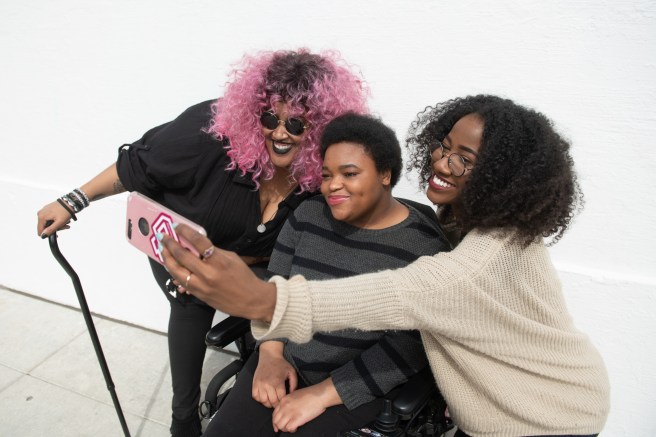
Build movements that can be self-critical
I’m not sure if anyone yet knows precisely how much of a factor Labour’s failure to properly engage with allegations of antisemitism played in its defeat, but it was depressingly reminiscent of a pattern I’ve seen repeated in any number of movements over the years. A trans woman raises concerns about transphobia in a feminist group, a disabled person points out the ableism in an environmental campaign, a person of colour explains that XR’s use of arrest as the primary strategy locks them out of leadership roles, or a woman or number of women come forward with evidence that a key organiser is a predatory sexual abuser. And unfortunately what usually seems to happen is that the wider movement tells the victim that they need to look beyond their individual concerns because the goals of the movement are more important. This usually results in the group splitting off into two smaller group, each which have proportionally fewer resources and less reach and one of which is still doing the harmful thing that caused the problem in the first place.
We need to acknowledge that all movement are made up of flawed human beings who have absorbed the biases of society, and some of whose motivations in becoming activists may not be entirely benevolent. We can’t be afraid to admit that we sometimes make mistakes, say the wrong things or give power to the wrong people, and when we do we need to fix things. We need to understand that it’s not the responsibility of the section of the movement being harmed or marginalised to put aside their concerns in the interests of unity “for the greater good”, it’s the responsibility of the rest of the movement to listen, take concerns seriously and make amends to keep that section in the movement in the interests of unity. Our progressive movements should not replicate the same oppressive, kyriarchal power dynamics that exist in wider society, not just because it’s the right thing to do but for the entirely self-serving reason that we need as many people working with us as possible, and we need diverse perspectives to solve complex problems.
Hope
Looking at the world right now it’s hard to see much grounds for hope. Brexit is coming at the end of the month, homelessness, food bank use and hate crime figures all continue to rise, Australia is on fire, and only two weeks in to the new year the dangerously unstable leader of the most powerful nation on Earth has almost brought us to the brink of war. But hope is not an external thing, not an objective evaluation of the state of the world but a personal determination to keep fighting for it. It’s a discipline, an act of faith. In the words of Laurie Penny
Hope is not thinking positive thoughts. Hope is not self-delusion. Hope is clinging to the life raft and kicking, even when there is no sight of land. Hope is a muscle. Like most muscles, it hurts like hell at first, but it gets easier as you get stronger, and you get stronger the more routine, seemingly pointless work you put into it. It is possible. It’s not easy. It takes the sort of work, every day, of doing what needs to be done to care for yourself, your community, your society, even when you resent having to do so and would rather lie down for five minutes or five months or the rest of your life. That’s hope. It’s not a mood. It’s an action. It’s behaving as if there might be a future even when that seems patently ridiculous.
We have no evidence that we can make things better, but we have to try, because the alternative is unthinkable. And though I can’t know whether we can do it, I believe that we can, because we’re all going to do it together.
Let’s make 2020 better than 2019.

 Tangled Bank Foraging and Fibre Crafts
Superb post Jules.
Sorry to have missed you in London for the golden wedding shindig.
Hope all is OK in the SW.
From Doug MD. (Ex Twitter, ex Facebook, ex Instagram, still with WhatsApp though… just).
LikeLike
Good to hear from you Doug, hope all’s well with you. We’re not in Exeter yet – it’ll probably be late March/early April – but it would be lovely if we could catch up with you guys maybe some time this year now we’ll be closer in terms of train connections anyway, if maybe not strictly in terms of distance.
LikeLike