

Last night my partner and I went to see Mikaela Loach, climate justice organiser and author of “It’s Not That Radical” in conversation with Kalkidan Legesse at Bookbag, Exeter’s independent bookshop.

Forgive me for summarising, I would really urge people to read her own words in her book and on her posts, but much of the talk covered similar themes to her book, that the struggle for a healthy planet and for safe, full and dignified lives for the entire human race are inextricable connected and treating environmentalism and social justice as separate movements does an injustice to both and hampers the amount of progress we can make in either struggle. The idea that those with economic power are free to take whatever they like and use it however they wish, and that the systems they create to ensure this state of affairs continues will always be biases in their favour, lies at the root of both problems. The worldview that sees the natural world as mere resources to be extracted and a dumping ground for waste products is inseparable from the worldview that sees some humans as important and others purely in terms of their utility as consumers or labourers, or an inconvenience to be at best ignored or at worst eliminated when they live in land that could be more profitably occupied by someone else or when their health will be harmed by pollution or sweatshop labour.
The environmental movement has ignored the social justice aspect of the struggle for a better world for too long, and by failing to tackle the root causes of the problem we risk merely tinkering round the edges by substituting green capitalism for petrocapitalism. If we simply swap petrol cars one for one for EV’s for example we risk simply shifting harm onto the communities around lithium mines and battery disposal facilities, and meanwhile the poor still have no access to reliable, affordable public transport or safe active transport routes to get to work, school or doctors’ surgeries. We can offer grants for homeowners to improve their insulation and switch gas boilers to heat pumps and our gas dependency will decrease, but renters will be stuck paying more to heat less efficient houses. Wealthy people in South Africa can become self sufficient in electricity with solar panels, but by removing the best paying customers from the electricity companies the poor get less reliable power.
How is it that we already have so many solutions to the climate crisis that don’t compromise human rights or justice, but the only solutions being seriously considered are the ones that do?
Mikaela Loach, It’s Not That Radical
The environmental movement has always had a problem with diversity. A recent study from the University of Birmingham found that only 5% of the UK’s environment and climate professionals identify as being from an ethnic minority background – compared with 13% across other professions. In a recent study of climate policy and action events in Bristol, researchers found that ethnic minority voices make up around 3% of climate policy and action discussions, speaking only 1-2% of the time, on average. In contrast, white men spoke for 64% of the time. This means that while communities of colour who are on average less well off financially are more to live near the environmental hazards our consumerist culture creates: by incinerators or waste processing plants, or in high traffic areas where air pollution damages children’s lungs and noise pollution damages their concentration in school and hence their life changes, the concerns of more privileged people will be priorities in the movement. And this weighting is magnified globally: while it is the carbon profligacy of the global North that caused the climate crisis, it is primarily the global South that suffers as pacific Islands slip under water, hurricanes batter the Caribbean and pilgrims die of heat exhaustion during the Hajj. I really wish that live talks came with citations – I believe that Mikaela Loach said that Just Stop Oil recently voted not to campaign on the issue of climate reparations, deciding that it “diluted the core message”, but I may have misheard the organisation name. Regardless I have personally encountered far too many arguments in environmental groups when anyone brings up and issue of racial, gender or disability justice with people dismissing inclusivity concerns as a side issue that gets in the way of the real work.
While this is obviously a problem for the marginalised communities neglected by the environmental movement, too many within the movement don’t seems to realise that this is a great loss to the movement itself. Not only do the struggles for civil rights and social justice have a great deal to teach us about how to organise and sustain a movement over the long term and in the face of setbacks and opposition. Mikaela Loach shared the following quote during the talk:
We didn’t include gender issues in [earlier] struggles,” she says. “There would have been no way to imagine that trans movements would effectively demonstrate to people that it is possible to effectively challenge what counts as normal in so many different areas of our lives.” She smiles. “A part of me is glad that we didn’t win the revolution we were fighting for back then, because there would still be male supremacy. There would still be hetero-patriarchy. There would be all of these things that we had not yet come to consciousness about.”
and said that it made her realise that the future she could imagine could never be the best future possible, because she was only one person coming from her own worldview. The true future we were working towards would be even better because it would be informed and built by a number of different people with a diversity of viewpoints that she had never even thought of. And just as the problems go hand in hand the solutions do too; building a more sustainable future inherently means building one in which humans can thrive as well as the planet.
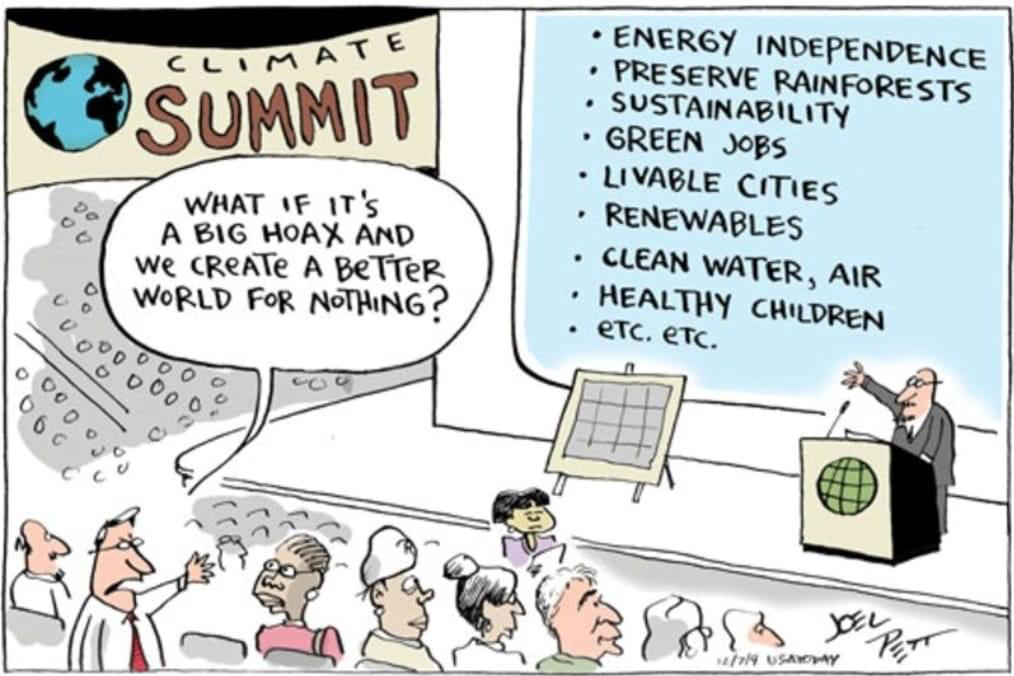
And the bulk of her talk was about how we need movements to reach that future, that the sum of individual actions will never bring about change but that by working together we can get there. And although the voices that shout loudest may give us the idea that most people are opposed to this in reality most people are for a better world, they just don’t know how to go about making change or don’t believe they have the power to. And by coming together and organising we can change that.
Consumers’ cannot stop climate change because capitalism is not compatible with a climate-just world. But active citizens CAN. Movements CAN. WE CAN when we challenge and disrupt these systems, rather than limiting our power and actions to those which are within it.
Mikaela Loach, It’s Not That Radical
I was very impressed by how humble and willing to share credit she was. She was asked about her bravery speaking at the #Shell AGM on behalf of the people of the #NigerDelta suffering and dying from their pollution and human rights abuses, and turned the question round to say she got the recognition as the most visible person but the people in the Niger Delta who gave her the information and wrote the speech, the person who bought the Shell share that allowed her to attend and the friend who filmed it were just as important and the speech couldn’t have happened without them. I know that praising a Black woman for her humility could be seen as problematic, but this is a trait that I greatly admire in movement leaders of all ethnicities. Particularly in todays influencer era there are far too many messianic leaders who start to believe their own hype, Roger Hallam or Julian Assange being prime examples.
And what I personally found most inspiring was her repeated insistence that there was space in the movement for everyone, that different viewpoints and skillsets could all contribute. We don’t all have to be the one who stands up in front of a hostile crowd or opens ourselves up to public criticism on social media, we can be the one who carries out and summarises the research, makes sure the Zoom works properly, interprets a conversation or plans a better way of dealing with our food waste. She concluded by saying that while we need people drawing attention to the fact that the ship we’re on is sinking, it wouldn’t do much good if no one was building the lifeboats we need to get off the ship on to. So we need to be actively building the communities and systems we will need to sustain us, not just sounding the alarm. Everyone has something valuable to offer to the struggle for a better world.
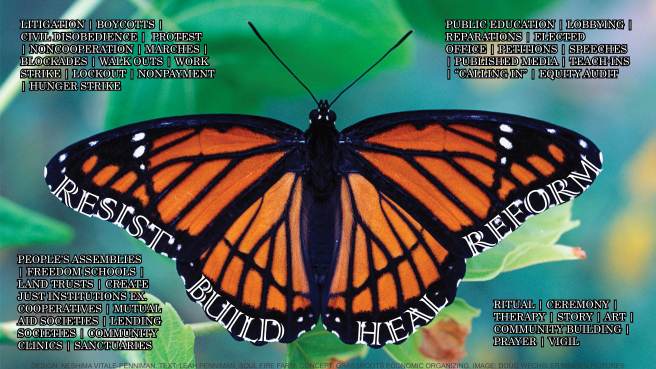
Resist:
- Litigation
- Boycotts
- Civil disobedience
- Protest
- Non-cooperation
- Marches
- Blockades
- Walkouts
- Work strike
- Lockout
- Non-payment
- Hunger strike
Build
- People’s assemblies
- Freedom Schools
- Land Trusts
- Create just institutions
- Cooperatives
- Mutual aid societies
- Landing societies
- Community Clinics
- Sanctuaries
Heal
- Ritual
- Ceremony
- Therapy
- Story
- Art
- Community Building
- Peyer
- Vigil
Reform
- Public education
- Lobbying
- Reparations
- Elected office
- Petitions
- Speeches
- Published media
- Teach-ins
- “Calling in”
- Equity audit

 Tangled Bank Foraging and Fibre Crafts