
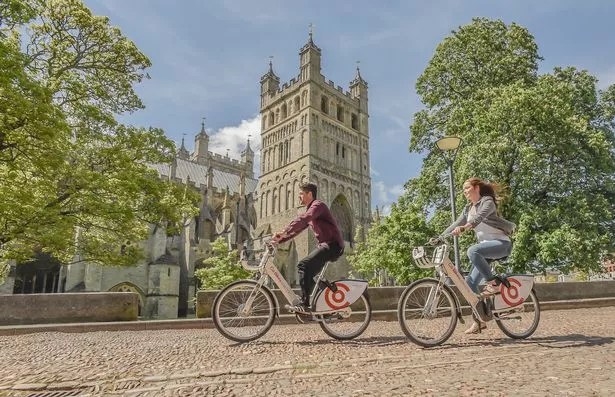
I woke up this morning to the depressing news that CoBikes, Exeter’s bike and electric car hire scheme, had gone into administration and would be ceasing operations. Sadly I can’t say I’m entirely surprised. CoBikes were an absolute lifesaver for me during the pandemic when, thanks a hasty decision to prioritise bringing my plants home and a job move during lockdown, my own bike ended up locked in the boiler room of a building I couldn’t access for eighteen months. I continued using them intermittently afterwards, seduced by the ease with which the battery sent me soaring up hills, but found myself doing so less and less in recent months as it became harder to actually find an available bike. Presumably everyone else was doing the same, leading to a downward spiral of less hire revenue, less to spend on maintenance and ever fewer bikes available.
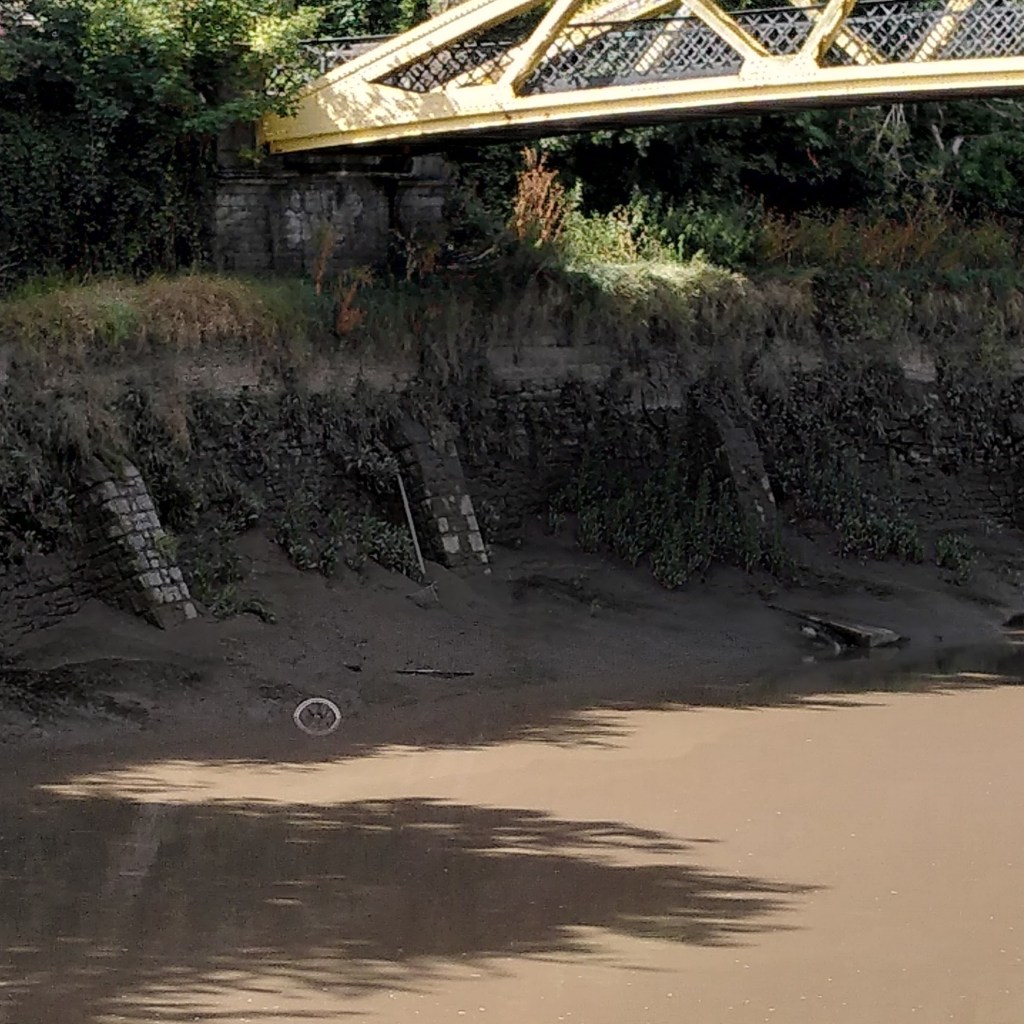
Vandalism was also a factor in CoBike’s failure to remain viable, with the the destruction of the docking station in Cranbrook apparently serving as a factor. This is what ended Bristol’s Big Issue bike hire scheme which was apparently having the equivalent of the entire fleet of bikes destroyed every two weeks. I tried to use these hire bikes three times and never managed it, once because the bike I found was broken, once because it was being used by an unhoused person sleeping next to it to store his belongings and once because, after walking up and down the riverside searching for the dockless bike the app assured me was nearby, I eventually found it.
I’ve no doubt entire theses have been written on the sociology of vandalism, which is not in any shape or form my area of expertise. I do wonder though if the vandalism of hire bikes, street art and public planters is part of the “nice things for middle class people” phenomenon, that people resent seeing money spent on making things nice for groups they don’t perceive themselves as belonging to when their own basic needs for food and shelter are ignored.
Ultimately however much of a role vandalism played, and how much was down to increased energy costs, it seems the cooperative simply wasn’t profitable enough to sustain itself. And we live in society where whether something survives depends not on how useful it is, how much it enriches our lives or reduces our impact on the planet, but on whether it can consistently turn a profit.
While believing comments in local Facebook groups are in any way representative of public opinion is a recipe for instant despair, I was sad to see a few gleeful comments on the scheme folding along the lines of “People should buy their own bikes instead of expecting the council to pay for them.” And sadly I’ve seen variations of this idea all over the place. Whatever you think of Insulate Britain’s methods, they have some extremely sensible demands:
1) That the UK government immediately promises to fully fund and take responsibility for the insulation of all social housing in Britain by 2025.
2) That the UK government immediately promises to produce within four months a legally binding national plan to fully fund and take responsibility for the full low-energy and low-carbon whole-house retrofit , with no externalised costs, of all homes in Britain by 2030 as part of a just transition to full decarbonisation of all parts of society and the economy.
and yet I was quite surprised to see among the rest of the vitriol on social media variations on the theme of “They should pay for their own insulation instead of expecting us to.”
The fact is that better insulated houses benefit everyone in the country, whether they personally receive insulation or not – with energy supplies constrained by the invasion of Ukraine, reducing our energy consumption for domestic heating would go some way toward mitigating the threat of blackouts this coming winter. While it should hopefully be self evident that children not dying of mould inhalation is a good thing, fewer people living in damp and draughty conditions would also mean the NHS would need to devote fewer resources to treating respiratory conditions. Hire bikes don’t just benefit the cyclists themselves, if they replace car journeys they reduce traffic congestion, particulate pollution, competition for parking spaces and road accidents. And of course both insulation and cycling have the public benefit of helping to reduce carbon emissions and help keep our planet habitable in the face of runaway climate change (“But why don’t they just buy their own air conditioners?”).
We seem to be increasingly moving away as a country from the idea that a public social good can exist independent of the benefits to individuals. We’ve gone from a broad post-war consensus that an educated populace is a good thing to have, and hence university education should be provided for free, to the idea that a degree is a personal investment in optimising your future earning power. We seem to be drifting terrifyingly from the idea that a healthy population is also a good thing to have, that “Illness is neither an indulgence for which people have to pay, nor an offence for which they should be penalised, but a misfortune the cost of which should be shared by the community.” to the idea that you should invest in your own health by taking out private insurance, getting a private dentist, personalised supplements and a personal fitness plan and if you don’t you’re just being a burden on the rest of us and you should really have thought about that before you selfishly decided to be too poor to be able to afford it. I’ve always believed that the point of coming together in groups – organisations, collectives, nation states, societies – should be to organise ourselves to accomplish things we couldn’t on our own and in doing so make life better for everyone. Instead the current Conservative consensus is that we need to organise things to remove any obstacles to people pursuing their own enrichment, whatever effect that has on anyone else.
George Monbiot came up with the concept of public luxury, private sufficiency to define the sort of world we as environmentalists are aiming for, the idea that everyone should have their fundamental needs met and we can then allocate excess resources to things that improve life for everyone: public healthcare systems, public transport, urban nature reserves, swimming pools, nurturing schools offering arts and music and trips, community gardens, libraries of books and of things, and yes, bike hire schemes. Instead we live in a world where many people live below the breadline but those who don’t have access to more personal luxury than at any previous time in human history, and we’re told there’s nothing to allocate to shared public goods; “do more with less” is a mantra in the public sector, “there’s no magic money tree”, we all just need to accept that we’re poorer. But this isn’t an immutable law of nature but a decision on resource allocation by those in power; money is funnelled into roads and parking spaces to facilitate the private luxury of car ownership, instead of the public good of public transport and cycling infrastructure, into a subsidy to maintain the profitability of fossil fuel companies instead of invested in renewable energy, insulation and efficiency measures, into the bare minimum to fix health problems rather than ensuring schoolkids have a decent diet from the outset.
It’s also worth noting incidentally that one person’s “luxury” may be another’s “convenience” may be another’s “necessity”. “Convenience to many of us means ‘not quite collapsing under the strain’”. No one needs a plastic straw to avoid smudging their lipstick, but people with some disabilities need them to drink safely. When most of us are struggling financially, Amazon is cheaper than the local shop in the town centre. When people are juggling multiple jobs and inadequate childcare, next day delivery can be a lifesaver. When you’ve had a long day and are exhausted and miserable because you’ve been trying to work around systems that increasingly don’t work, in a job you don’t like, to pay ever more unaffordable rent, and you don’t have the energy to cook, it’s nice to be able to order a takeaway. There’s actually a name for the tendency for consumers to buy little treats as a pick-me-up during bad times, the Lipstick Effect. We shouldn’t be shamed for this, but surely as a society we should be able to aspire to better. Instead we’re told the best we can aspire to is being able to afford more of the luxuries that make the status quo bearable. What if our little treats weren’t new lipsticks but liveable cities, not fishnet tights but a functional social safety net.
And this is why it has been so easy for the media who set the public narrative to position environmental groups as the enemy, as a threat. “Look at those hair-shirted killjoys!” they scream. “They want to take away your cheap holiday flights, your daily cheeseburgers, your £6 Boohoo dresses, your plastic glitter, all the little private luxuries that make life bearable!” And the truth is we do, because all of those things make life unbearable for some people in the short term and will for all of us in the long term. The bit that gets missed out of this shrill harping is that we want to replace them with affordable, reliable train and coach travel for all, with unpolluted beaches you don’t need to fly abroad to find and walkable cities with beautiful, safe parks for everyone, with libraries that open at a time that actually allows you to visit them, free museums and cultural events. We want nutritious, affordable food for all, locally grown without depleting the soil by people paid a fair wage and distributed by resilient supply chains. We want people to be able to afford clothes that don’t fall apart after one wash and have to be replaced so they cost more in the long run, for everyone to be able to express their identity and sexuality safely, for teen girls not to be pressured to buy a new outfit for every selfie and live up to the impossible standards of Instagram filters. We want the public luxury of a fulfilling life for everyone, because we all deserve joy, comfort and opportunity, not just those who society deems worthy because of their bank balance.
We are all far closer to homelessness than to ever becoming a billionaire, so defending the latter at the expense of the former only works to benefit the capitalist elites and harm the rest of us. Yet so many people are made to believe that they have more chance of one day joining the billionaire class or 1 per cent elite than of achieving an economy that works for us all – even though that chance of extreme wealth is almost impossible. Rather than fighting for that better world, they choose to protect the right of the 1 per cent to exploit and overconsume, just in case there is an opportunity to one day step into that world. These actions or aspirations don’t come from a place of wishing exploitation on others, but instead from one of truly feeling that this is the only choice that will offer protection and stability.
Mikaela Loach, It’s Not That Radical
Instead we’re told we have to accept rivers too polluted for wildlife or swimming as the price we pay for cheap chicken, and we have to accept we need cheap chicken because people are too poor to pay for better quality nutritious food. We have to accept that we need our transport system to revolve around cars because disabled people need their own vehicles, and we have to accept disabled people need their own vehicles because almost 40% of UK stations still lack step-free access and passenger support is usually inadequate or unavailable. Why can’t we do better than this? Why can’t we dream bigger? We’re a species that put people on the moon and invented vaccines and the internet and Moka pots and sriracha mayonnaise. Why can’t we use that creativity to imagine a world where things don’t inevitably get worse?
We live in capitalism. Its power seems inescapable. So did the divine right of kings. Any human power can be resisted and changed by human beings.
Ursula Le Guin

 Tangled Bank Foraging and Fibre Crafts
You connect so many of the things I’ve been reading about over the last few weeks and in such a readable way. I finished Less is More by Jason Hickel, while it Italy. The British media love to mock Italy, but it has so much bigger, broader commons than we do. Scooter and bike hire schemes seem to thrive. The bus and train networks. Car free city centres at weekends. Free open air film screenings. Large, well staffed libraries.
Britain is fast becoming the US with ever more extreme inequality, depleted public services, and an isolated, divided, unhealthy population fed consumerism and selfishness by the organs of the powerful.
LikeLike