
With the caveat that environmentalism is increasingly framed as a matter of individual consumer choices rather than collective action, which is bad news both for the movement’s likely effectiveness and the way we think of ourselves and one another in society, I do nevertheless believe that personal environmental choices are worth making. This is not only because while the impact of individual actions may be tiny this is better than having no impact at all, but because personal actions certainly work for me to give me a sense of agency that helps combat feelings of despair at the scale of the problem. It’s easy to feel overwhelmed at the magnitude of the problems facing us as a species in reducing the harm we do to the natural world that sustains us, so anything I can do to mitigate these feelings becomes an act of self care more than planet care. And while self care is often positioned as selfish, if my depressive breakdown and subsequent difficult recovery have taught me anything it’s that if you don’t care for yourself you’re in no position to support others.
What follows is a list of some actions I’ve been able to take to reduce my use of single-use materials. For me they have been simple but I realise that everyone’s life circumstances are different and for some people they may be more challenging. Ironically almost all of these recommendations involve buying something, but using it more than once will reduce overall consumption.
- Carrying a reusable water bottle you can top up instead of buying bottled drinks will not only reduce waste but will probably save you money in the long run.
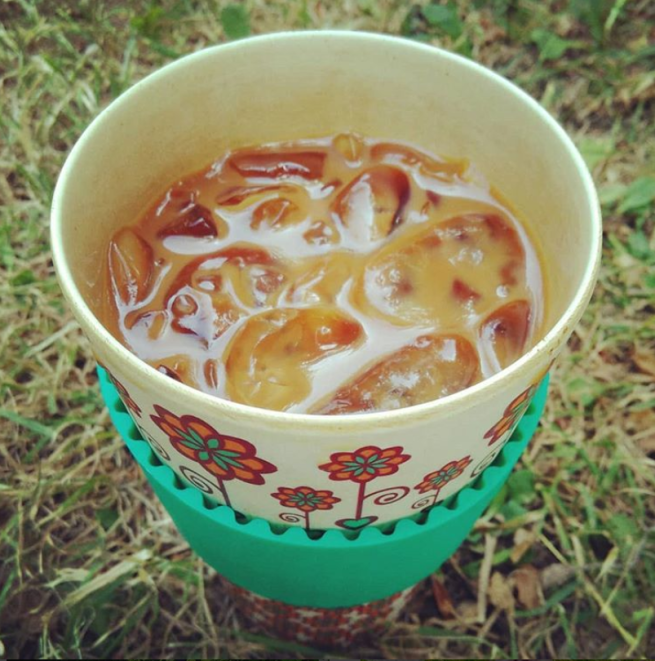
- A reusable coffee mug certainly saves me money by encouraging me to make a coffee before leaving instead of buying one, but some places offer discounts for using one too.
- For people who menstruate there are a number of reusable alternatives to tampons and pads. I use a Mooncup and have also heard good things about Meluna but everyone’s body is different and I realise menstrual cups don’t work for everyone. I’ve never tried reuseable pads myself, but they’re widely available here are a number of sellers on Etsy or you could make your own by following this link. Updated 21/8/19: I wrote a more detailed post on reusable menstrual products here.
- Reusable shopping bags means you save plastic and the 5p charge. I’d imagine everyone has at least one reusable cotton tote by now because conferences, shops and universities seem to hand out promotional ones left, right and centre, but if you wanted to buy something I recommend Turtle Bags. These are basically Bags of Holding that can stretch to accommodate just about anything, and have the added advantage that I once managed to convince an extremely drunk friend that they were made of fibre spun from recycled turtle shells.
- Reusable sandwich wrappers are a good substitute for single use sandwich bags sandwich bags. Mine is from here. Alternatively you could do what my former landlady used to do and wash and reuse ziplock bags – I do think the modern environmental movement has a lot to learn from older generations and people from less affluent countries than the UK who have lived through times of scarcity.
- Use rechargeable batteries (this will involve buying a battery charger too). Battery recycling, while better than the alternative, is by no means perfect (pdf) – it’s labour intensive, unable to recover all the materials used, often economically loss-making and in 2009 only 13.6% of batteries ended up being recycled. While rechargeable batteries will still eventually degrade too after a certain number of charge and discharge cycles, they will at least last longer than single use ones and so reduce the overall volume of battery waste produced.
- Washing up sponges. I first tried compostable coconut Safix Scourers as an alternative to plastic sponges, but found that while they were good for scrubbing off baked on food they weren’t much good for anything that needed more gentle cleaning like kitchen surfaces, and their structure as a meshwork of coconut fibre with big holes in meant it was very easy to miss bits. I then switched to cotton ones which I find work a lot better. It should be noted that these are expensive – I was basically too lazy to make my own, but it would be very easy to do so with some scrap cotton and hessian. It’s also worth noting that this works for me because I boil wash my sheets (my cat sleeps in bed with me so I feel it’s more hygienic) and just throw them in the wash at the same time, but I realise that uses a lot of energy and many people prefer to do laundry at lower temperatures. (Update: a friend of mine also recommended these.)
- Cotton handkerchiefs. I have to say switching to these from these has been a revelation: not only has it saved me money and a huge amount of plastic wrapped around pocket tissues, but they’re also much softer and less scratchy on your nose when you have a cold and as an added bonus if I forget one in my pocket before doing laundry it doesn’t cover the whole load in little shredded white flakes.
- Moving on to things that won’t save you money because they replace things given away for free, but will still reduce your impact: you can carry your own travel cutlery instead of getting disposable with takeaways.
- Carry Tupperware – many takeaway places will be happy to fill your own container instead of providing a disposable one, and some even offer a discount for doing this. For Brighton-based folks I’d like to give a shout out to Crocus Paella, Earthlings Edibles (considerably less weed-based than the name suggests) and Curry Leaf Cafe for being happy to do this. Update: I since discovered Wriggle has a list of venues in Brighton and Bristol encouraging you to bring your own box.
- You can also get mesh bags to use instead of single use plastic bags for buying loose fruit and vegetables.
- Ask your employer to reduce their use of single use products. I’ve managed to get my work to stop ordering plastic cups for the water fountains, and to often use proper mugs in meetings instead of disposables, purely through the power of being a bit annoying on the subject over a long period of time.👍
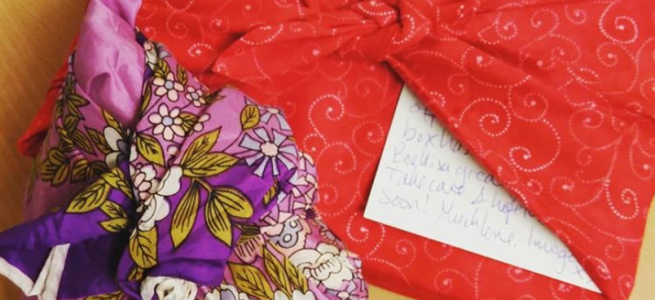
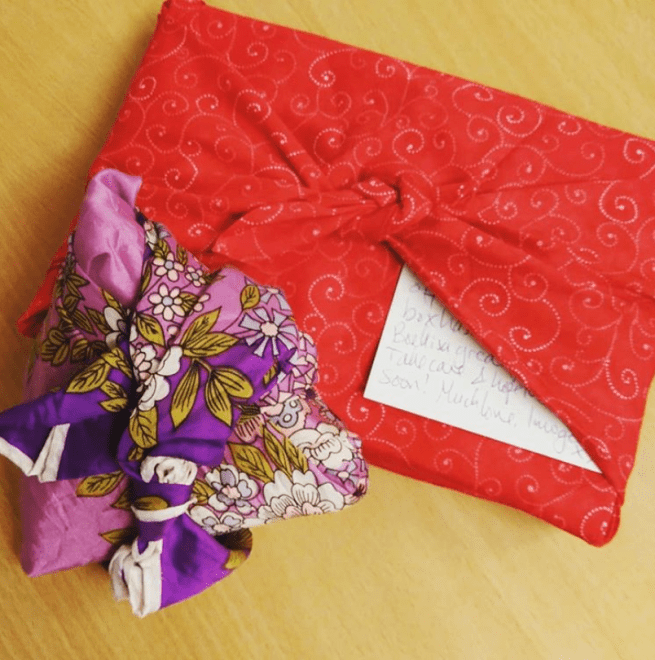
- With Christmas approaching consider wrapping gifts in reusable fabric or charity shop scarves rather than single use wrapping paper (which may not even be recyclable if it has foil or glitter designs). The recipient can keep the scarf,donate it back to a charity shop or use it to wrap their own gift – my friend Imogen and I have been passing the same purple scarf back and forth at birthdays and Christmases for a few years now!
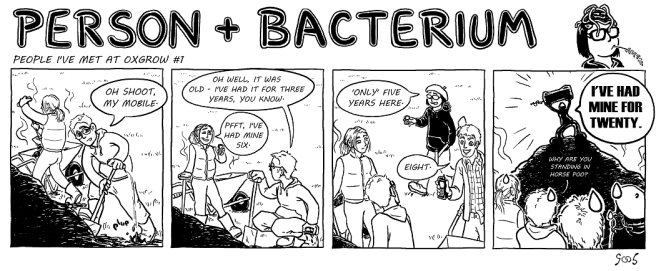
Finally, while electronic devices aren’t single use they do tend to have a much higher turnover than they strictly need to both due to planned obsolescence and fashion. The most sustainable mobile phone you can have is your existing phone, or a reconditioned phone, and a lot of exciting initiatives like the Restart project are starting up to empower people to understand and repair their own gadgets and so extend their useful life.
If you do need a new phone, the Fairphone 2 is not only guaranteed to be free of conflict minerals and assembled in factories that guarantee standards of working conditions, but is also designed to be easily upgradeable to extend its useful life as long as possible. The case is designed to be easy to disassemble and nothing is glued down, and the components are modular, making it incredibly easy to swap out broken components or to upgrade to a camera with higher specifications without having to replace the whole phone. (However unfortunately the takeback program for old components is no longer operating.) The specifications are also available to 3D print your own phone case. I have a Fairphone 2 and would definitely recommend it on environmental grounds, though it is worth noting that it does get very hot, especially when charging, presumably because the modular design means heat sinks aren’t quite as closely integrated as they would be in a phone assembled as a single piece. This does mean it sometimes shuts down unpredictably when it gets too hot, and while you should be careful not to leave any phone charging somewhere heat cannot dissipate I would say this might be a particular risk with a Fairphone.
As I said at the beginning of this post, I recognise that making individual choices about the way you live your life are less effective in reducing the impact humans are having on the planet then organising for widespread systematic, societal or political change. I also recognise that I am in a very privileged position both globally and nationally, and that the people with the most choices available to them in society, because of resources, education, health etc, are also going to be the ones with the most freedom to make environmental choices. It’s therefore important to understand that making more sustainable choices is not a reflection of anyone’s individual morality or a reason to feel smug about oneself. Any evaluation of moral virtue that considers the choices of available to the privileged more virtuous is inherently flawed.
With that said I hope some of the ideas I have outlined above may be things you might consider adopting in your lives. Even if it’s just one change, even if it’s not done consistently, indeed even if it’s a one off action, tiny reductions in impact still add up.
It’s better to light a candle than curse the darkness – Peter Benenson, Amnesty International

 Tangled Bank Foraging and Fibre Crafts
I have always used a proper pocket handkerchief – for exactly the same reasons
LikeLiked by 1 person